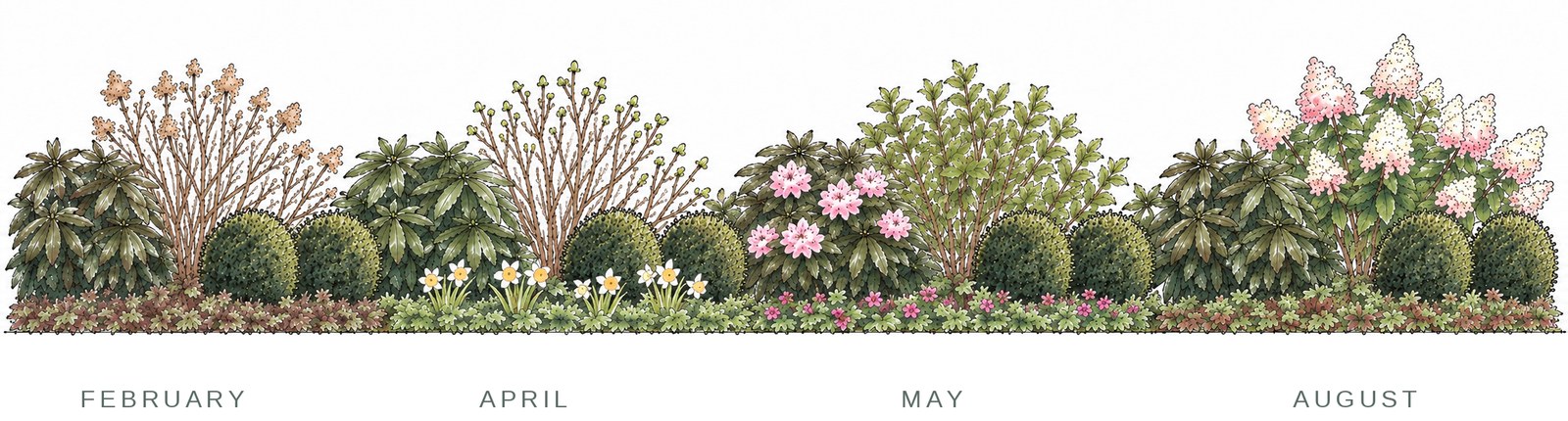
The same bed, through the season. Every Bloom Days plan is drawn across the season, not as one flattering picture, because a garden evolves, and you should see the whole vision before you plant it.
A planting plan built around your site. Made for the way your neighborhood actually looks, that reads as beautiful to your neighbors and as habitat to everything else.
New England · Mid-Atlantic · more regions soon
The same bed, through the season. Every Bloom Days plan is drawn across the season, not as one flattering picture, because a garden evolves, and you should see the whole vision before you plant it.
You usually have to choose. A garden that looks designed, or a garden that attracts pollinators.
Bloom Days does both.
The complete working documents for a single garden area. A bed, a border, a pond edge, an entry. Ready to order from, plant from, and live with.
Every plant with plain-language reasoning underneath: what you'll see, and why it survives your site.
April to October, no dead months, and a second row naming who visits each month: bees, butterflies, hummingbirds.
Drawn to your measurements, with quantities and the exact nursery sizes to order.
Growers within an easy drive, plus the wholesale bulb and plug houses that sell to anyone. Plugs and bulbs cost a fraction of potted plants, which is what makes real drifts affordable.
Written for whoever's actually digging: you, or your landscaper.
The bed drawn side-on, to scale, in April, June, August and October. Four drawings, because one would imply everything blooms at once.
How many hours a year this bed takes, and in which months. You get the number before you plant, not after.
Each plant's bloom in its true color, and underneath it the row most designers never show you: who actually visits, month by month. Bees, butterflies and hummingbirds want different things, so a bed can be covered in flowers and still be feeding almost nobody.
| Apr | May | Jun | Jul | Aug | Sep | Oct | |
| Daffodils | |||||||
| Wild geranium | |||||||
| Butterfly weed | |||||||
| Coneflower | |||||||
| Showy goldenrod | |||||||
| Who visits |
Look at April. Daffodils open the season and feed almost nothing, so this sample has a hole in it. That is what the row is for, and it is why this palette is not finished. Yours is built from your site, your deer, your town. The seven arcs in the logo are the same idea: one arc per bloom, drawn from a real palette.
A full-service designer can charge thousands for a plan like this. Most of that is not design. It is hours: checking whether a plant takes wet clay, whether the deer on your road eat it, whether its bloom window leaves July empty. I built an AI studio to do that part. It checks every plant against your sun, soil and browse pressure, and every palette against a panel of design standards. That is why a Bloom Days packet costs $250, not $3,000.
What it does not do is choose. The plants in your plan are my picks, and every one comes with a reason in plain language. The rules I choose by were learned in my own garden, and from the storied designers whose work we can all learn from.
We are starting small in this region before we expand. We live here and know what works here: which "deer-resistant" plants actually get eaten in Pound Ridge, which inkberry cultivar dodges the boxwood blight running through Fairfield County, and which nursery on your own road stocks the plants in your plan.
Healthy shrubs, correct choices, and still bare. Bare turned out to be a layer problem, not a plant problem.
The English border everyone pins and nobody plants here, minus everything a Connecticut deer eats. A full plan for a bed I have not seen.
First packet: name and address removed at the owner's request, everything else exactly as delivered. Second: a template for a common bed, the same format.
Inputs such as deer or rabbit pressure shape the plan from the start. If it gets eaten in your town, it isn't in your plan.
Something blooms, and pollinators are happy, every month from April to October.
The test is whether a plant belongs in this region, not where its ancestors lived. If a well-behaved non-native earns its place, it's in.
That's what makes natural look deliberate instead of neglected.
The care plan tells you the real annual cost in hours before you plant, not after.
Six questions on this page, about two minutes. Photos and measurements come later, once we both know it is a fit. I answer within two days.
Not a sales call. Your style, and anything tricky: deep shade, deer, the slope you've been ignoring for years. Then we agree on every plant before anything is drawn.
Your packet arrives in time to order plants before the good ones sell out. Perennials go in through October and bulbs through November, so a plan this month is a garden next June.
I am taking a small number of gardens now, at $250 each, and choosing them as I have capacity so there is time to design properly and order plants before the good ones sell out.
Perennials go in the ground through October and bulbs through November. A plan this month is a garden next June. Anything that comes in after the planting window is designed over the winter and planted in spring.
Nothing is owed and nothing is decided when you send this. You are telling me you want a plan so I can reach out, and I answer every one myself within two days. This is the introductory price. It goes up after the first round. Connecticut, Westchester and the Hudson Valley, because knowing your deer, your soil and which nursery on your road stocks the plants is most of what you are paying for.
Bloom Days · Greenwich, CT · bloomdays.co · kaitlin@bloomdays.co